
For most of human history, organ meats were prized as the most nourishing part of the animal. Liver in particular is one of the most nutrient-dense foods there is, and heart, kidney and spleen are not far behind. The problem is that most people don’t like the taste or texture, and few people want to cook organ meats every week. Desiccated beef liver and beef organ capsules offer a simpler option. This guide covers what they are, what’s in them, and how to use them sensibly.
What is desiccated beef liver?
“Desiccated” simply means dried. Fresh beef liver is gently dried at low temperature to remove its water, then ground into a powder and put into capsules. Because liver is roughly 70% water, drying concentrates it: each gram of desiccated liver equals about three to four grams of fresh liver. Good-quality products use liver from grass-fed, pasture-raised cattle and avoid high heat, which helps preserve the nutrients.
What’s in beef liver?
Liver is often called “nature’s multivitamin” for good reason. According to the National Institutes of Health, a 3-ounce serving of cooked beef liver provides:
- Vitamin B12: about 70 mcg, or nearly 3,000% of the Daily Value. Liver is one of the richest food sources of B12 there is.
- Vitamin A (retinol): about 6,600 mcg RAE, over 700% of the Daily Value, in the preformed form your body uses directly.
- Copper: over 1,000% of the Daily Value.
- Choline: about two-thirds of the Daily Value.
- Iron: in the heme form, which the body absorbs more easily than iron from plants.
- Plus riboflavin (B2), folate, zinc, selenium and high-quality protein.
These nutrients play well-known roles in the body. B12, riboflavin and iron help with energy metabolism and red blood cell formation.* Vitamin A supports normal vision and immune function.* Choline supports normal brain and liver function.* Zinc and selenium support the immune system.*
Beyond liver: heart, kidney, pancreas and spleen
Liver gets most of the attention, but other organs bring their own strengths. Based on USDA nutrient data:
- Heart is a good source of B vitamins, iron and selenium, and one of the richer food sources of coenzyme Q10.
- Kidney is especially rich in vitamin B12 and selenium, along with riboflavin and iron.
- Spleen is one of the richest food sources of iron, in the easily absorbed heme form.
- Pancreas provides vitamin B12 and zinc.
An organ blend spreads your intake across several organs instead of relying on liver alone. That gives a broader mix of nutrients and less vitamin A per serving than a liver-only product.
Capsules vs. eating organ meats
It helps to be realistic about amounts. A typical daily serving of desiccated organ capsules is around 3 grams, which equals roughly 10 to 12 grams of fresh organ meat, or about a heaping tablespoon. That’s much less than a full serving of liver on a plate. So capsules aren’t a megadose. They’re a steady, easy way to add a small amount of a very nutrient-dense whole food to your diet every day, without the cooking or the taste.
That smaller amount is also a safety advantage. Because liver is so rich in vitamin A and copper, eating large portions of liver every day isn’t a good idea. Capsules make it easy to get a consistent, moderate amount.
Who might consider beef liver or organ supplements?
- People who want the nutrition of organ meats but don’t enjoy eating them
- Active people looking to support energy and recovery with a whole-food nutrient source*
- Anyone following a meat-forward, paleo or ancestral-style diet
- People who prefer nutrients from whole foods over isolated synthetic vitamins
What to look for in a beef liver or organ supplement
- Grass-fed, pasture-raised source. Cattle raised on pasture tend to produce cleaner, more nutrient-dense organs.
- Nothing else added. The ingredient list should be the organs and the capsule, without fillers or flavorings.
- Third-party testing. Look for products tested for heavy metals and contaminants and made in a GMP-certified facility.
Safety notes
- Vitamin A adds up. Preformed vitamin A has an upper limit of 3,000 mcg RAE per day for adults. If you already take a multivitamin with retinol, cod liver oil, or eat liver regularly, count those too.
- Pregnancy: high intakes of preformed vitamin A can be harmful during pregnancy. If you’re pregnant or trying to conceive, talk to your doctor before using any liver or organ supplement.
- Iron and copper: people with hemochromatosis, Wilson’s disease, or who’ve been told to limit iron or copper should avoid liver and organ supplements unless their doctor approves.
- Gout: organ meats are high in purines, so people with gout should check with their doctor.
- Stick to the serving size on the label.
Upward Nutrition beef organ supplements
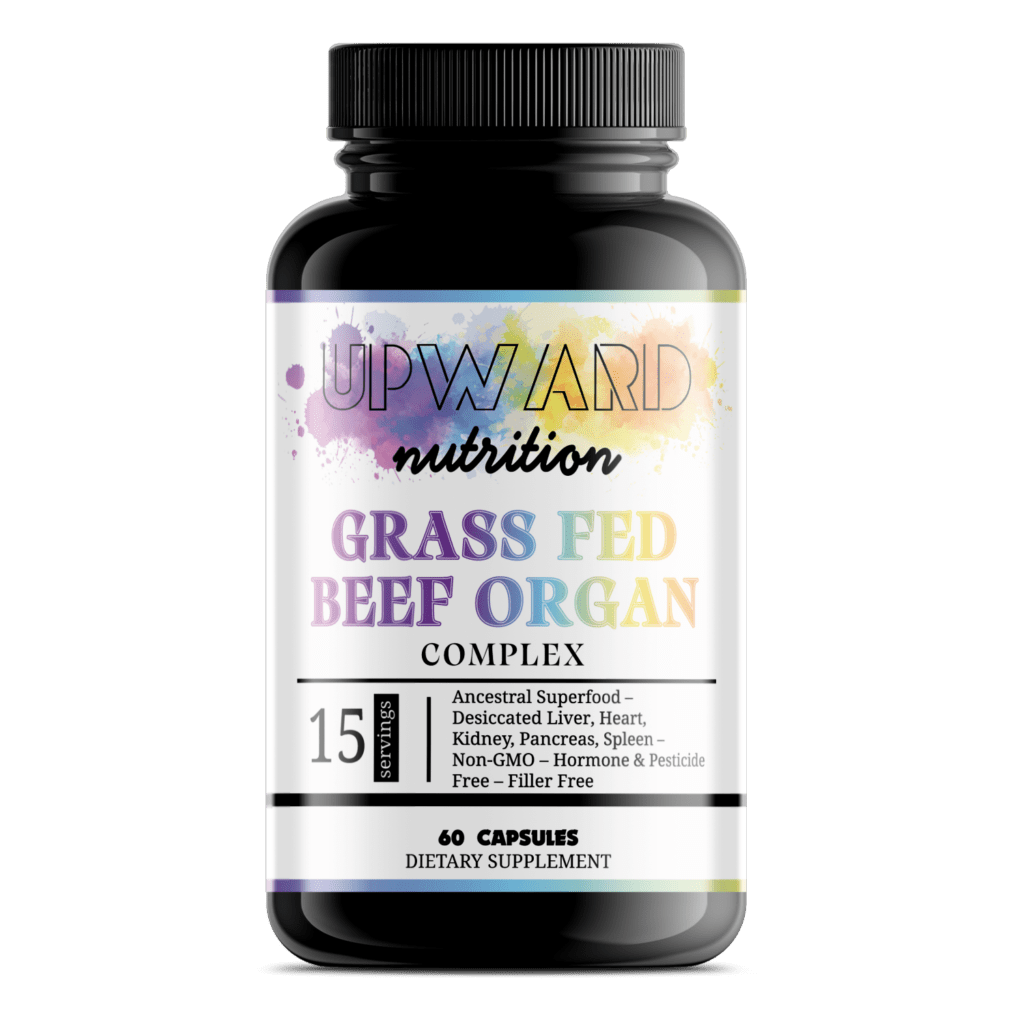
Our Grass Fed Beef Organ Complex combines five grass-fed organs (liver, heart, kidney, pancreas and spleen) at 600 mg each, for 3,000 mg in every 4-capsule serving. It’s a whole-food source of vitamin B12, iron, zinc, vitamin A and other nutrients that supports natural energy and healthy red blood cell formation.* Nothing else is added: just the organs and a gelatin capsule.
Prefer liver only? Our Grass Fed Desiccated Beef Liver provides 3,000 mg of grass-fed beef liver per 4-capsule serving. (It sells out from time to time; check the product page for availability.)
Both are hormone- and pesticide-free and non-GMO, made in the USA in an FDA-registered, GMP-certified facility, and third-party tested for heavy metals and impurities.
Shop Grass Fed Beef Organ Complex →
References
- National Institutes of Health, Office of Dietary Supplements. Vitamin B12 Fact Sheet for Health Professionals.
- National Institutes of Health, Office of Dietary Supplements. Vitamin A and Carotenoids Fact Sheet for Health Professionals.
- National Institutes of Health, Office of Dietary Supplements. Copper, Choline and Iron Fact Sheets for Health Professionals.
- U.S. Department of Agriculture. FoodData Central: Beef, variety meats and by-products (liver, heart, kidneys, spleen, pancreas).
*These statements have not been evaluated by the Food and Drug Administration. This product is not intended to diagnose, treat, cure, or prevent any disease. This article is for educational purposes and is not medical advice. Talk with your healthcare provider before starting any supplement, especially if you’re pregnant, have a medical condition or take medication.
